Simple vs. Compound Interest: Choosing the Best Method

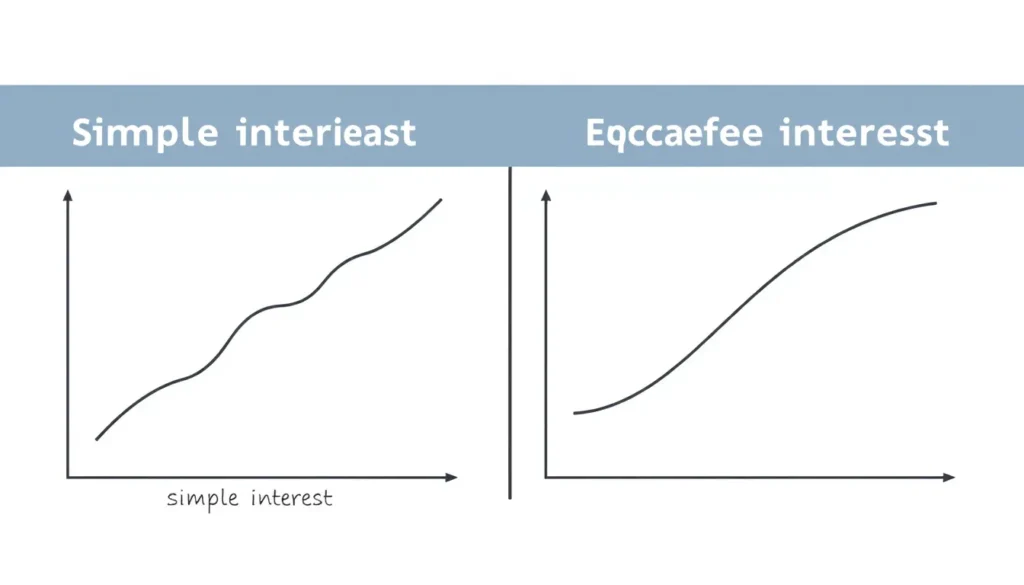
This guide is for anyone who needs to evaluate a loan, a savings plan, or any investment and isn’t sure whether Simple Interest vs. Compound Interest will give the right picture of cost or return. Whether you’re a student, a small‑business owner, or just planning personal finances, the steps below walk you through the process without advanced math.
By the end you’ll have numbers for both methods, know how to compare them, and be aware of pitfalls that often lead to mis‑calculations. You’ll be able to choose the approach that aligns with your goal and move forward with confidence.
Gather the necessary numbers and define your objective
Start by writing down the four numbers that drive every calculation:
- Principal – the amount you borrow or invest.
- Interest rate – the annual percentage (as a decimal) applied to the principal.
- Time period – how many years (or months) the money will be outstanding.
- Compounding frequency – for the compound‑interest side, note whether interest is added daily, monthly, quarterly, or annually.
Next, clarify the objective that will guide your comparison. Write a single sentence such as:
- “Minimize the total cost of a $10,000 loan over 5 years.”
- “Maximize the future value of a $5,000 investment over 8 years.”
This statement tells you which outcome matters most: the lower total payment (loan) or the higher ending balance (investment). With the numbers and goal in hand, you’re ready to apply the simple interest formula and the compound interest formula and see how Simple Interest vs. Compound Interest performs for your specific situation.
Calculate simple interest step by step
Take the numbers you just gathered—principal, annual interest rate, and time period—and place them into the simple interest formula:
- Action: Compute the interest amount using I = principal × interest rate × time period. For example, with a principal of $5,000, an interest rate of 4% (0.04), and a time period of 8 years, the calculation is:
I = 5,000 × 0.04 × 8 = $1,600
The result ($1,600) is the total interest you will earn (or pay) under simple interest.
- Result: Add the interest to the original principal to get the final balance:
Final balance = principal + I = 5,000 + 1,600 = $6,600
You now have both the total interest and the ending amount that Simple Interest vs. Compound Interest will be compared against in the next step.
Calculate compound interest step by step
Now turn to the compound‑interest side of Simple Interest vs. Compound Interest. Follow these three actions to get the total interest and final balance.
- Select the compounding frequency. Decide how often interest is added to the principal—annually, semi‑annually, quarterly, monthly, or daily. This choice determines n, the number of compounding periods per year.
- Plug values into the compound interest formula. Use
A = principal × (1 + interest rate / n)^(n × time period).
Insert your principal, the annual interest rate (as a decimal), the chosen compounding frequency n, and the time period in years. Compute the exponent first, then multiply by the principal to obtain the ending amount A. - Derive total interest and final balance. Subtract the original principal from A.
Total interest = A – principal.
The final balance is simply A. This figure will be the counterpart to the simple‑interest result when you compare the two methods.
With the compound‑interest total in hand, you can now evaluate which approach aligns with your financial goal.
Compare the two outcomes and decide which fits your situation
Take the two totals you just calculated and line them up in a simple two‑column table. The left column lists the simple‑interest result (principal + interest from the simple interest formula), and the right column shows the compound‑interest result (principal + interest from the compound interest formula). This visual makes the gap between the methods obvious.
| Simple Interest Total | Compound Interest Total |
|---|---|
Next, subtract the simple‑interest total from the compound‑interest total. The difference tells you how much extra you would earn (or pay) by using compounding at the given compounding frequency. If the goal is to minimize cost—for example, a loan repayment—focus on the lower figure. If the goal is to maximize growth, such as an investment, the higher figure is preferable.
Finally, match the outcome to your original objective. When the objective was cost reduction, choose the method that yields the smaller final balance; when the objective was asset accumulation, select the method that gives the larger final balance. This direct comparison completes the Simple Interest vs. Compound Interest decision process.
Identify and avoid the most common mistakes
Now, watch out for common pitfalls that can distort the Simple Interest vs. Compound Interest comparison. Fixing these errors ensures the numbers you’ve calculated truly reflect your goal.
- Using the wrong rate period. Applying an annual interest rate to a monthly or daily time period (or vice‑versa) inflates or deflates the result. Always match the rate’s time unit to the time period you’re using in the formula.
- Ignoring compounding frequency. The compound interest formula requires the number of compounding periods per year. Treating a quarterly investment as if it compounds annually understates the final balance, while assuming daily compounding for a yearly‑only product overstates it.
- Mixing up APR and APY. The Annual Percentage Rate (APR) is a nominal rate; the Annual Percentage Yield (APY) already includes the effect of compounding. Substituting APR for APY in the effective annual rate calculation will give an inaccurate comparison.
- Forgetting to convert percentages. Entering “5” instead of “0.05” in the formulas reduces the calculated interest by a factor of 100, leading to a misleading conclusion about which method is better.
Correcting each of these mistakes aligns the two calculations, letting you decide confidently which interest method serves your financial objective.
Apply the chosen method to real‑world scenarios
Take the worksheet you just built and plug in your own principal, interest rate, and time period. Run both the simple interest formula and the compound interest formula exactly as you did in the tutorial. The numbers you generate become a personal benchmark for any loan or investment you are evaluating.
- Swap the rate. Increase or decrease the interest rate by a few percentage points, recalculate, and note how the gap between the two methods widens or narrows. This shows the sensitivity of each approach to market changes.
- Change the term. Extend the time period (e.g., from 3 years to 5 years) and observe the compounding effect. Longer horizons usually favor the compound method because interest earns interest repeatedly.
- Adjust the compounding frequency. Switch from annual to semi‑annual, quarterly, or monthly. Re‑run the compound interest formula and compare the new result to the unchanged simple interest outcome.
- Do a quick sanity check. Verify that the effective annual rate you derived from the compound calculation is higher than the nominal rate, and that the simple interest total is never larger than the compound total for the same inputs.
When the recalculated figures line up with your financial goal—whether minimizing cost on a loan or maximizing growth on an investment—you have a concrete confirmation that the chosen method is the right fit.
